
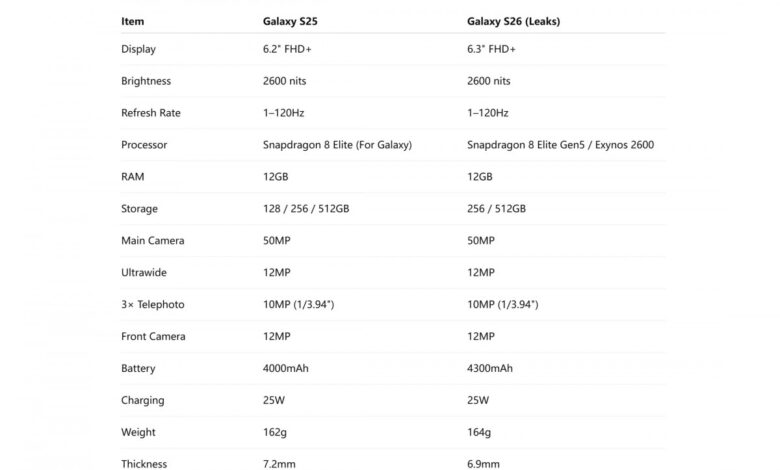
Recent reports, originating from the source known as Ice Universe, offer preliminary specifications comparing the anticipated Samsung Galaxy S26 and S26+ models with their respective predecessors, the S25 and S25+. The following analysis is based on the provided comparison tables.
According to the leaked information, the Galaxy S26 will feature incremental advancements over the S25. The display is projected to have a slightly larger screen size, while maintaining the same peak brightness and refresh rate. Other specifications, including RAM capacity, camera systems, and charging support, are expected to remain consistent. The S26 is anticipated to incorporate a 300mAh larger battery. Physical attributes indicate a 2g increase in weight and a 0.3mm reduction in thickness. A next-generation chipset is also expected. Storage configurations will begin at 256GB, with a maximum capacity of 512GB, mirroring the S25’s storage options.


The comparison between the S26+ and S25+ reveals fewer distinctions. The display specifications, encompassing size, resolution, brightness, and refresh rate, are expected to be identical. Furthermore, memory, storage capacity, camera configurations, battery capacity, charging capabilities, and thickness are projected to remain unchanged. The primary differentiation lies in the implementation of a new chipset and a 4g increase in weight. Otherwise, the specifications indicate nearly identical hardware configurations.

Samsung Galaxy S25
Samsung Galaxy S25+
Source