
Samsung Unveils Manufacturing and Testing Processes for Galaxy Z TriFold
Samsung has released details regarding the manufacturing and rigorous testing procedures employed in the production of its flagship foldable device, the Galaxy Z TriFold. This announcement highlights the company’s commitment to durability and reliability in its foldable smartphone technology.


[Insert Embedded YouTube Video: “Precision Engineering in Every Fold | Galaxy Z TriFold”]
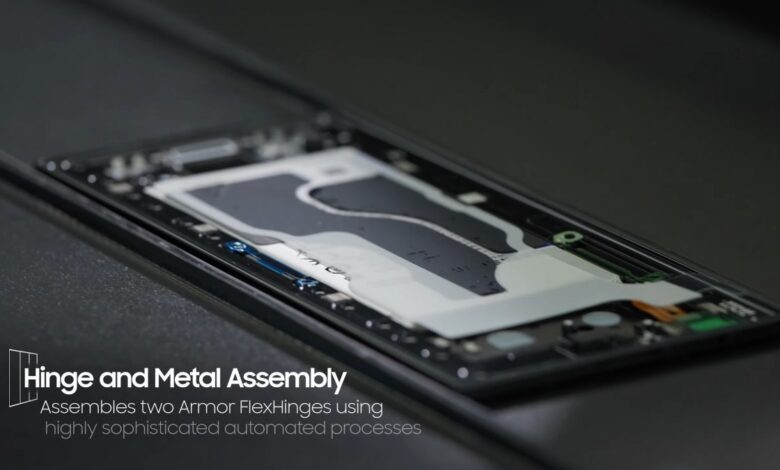
Leveraging a decade of innovation in foldable technology, Samsung’s manufacturing process begins with the titanium hinge assembly, incorporating two Armor FlexHinges. The assembly utilizes an automated system coupled with 3D laser scanning for comprehensive quality control of the main display.
To ensure long-term durability, the Galaxy Z TriFold undergoes an extensive folding test, designed to simulate 200,000 cycles. This testing regimen is equivalent to 100 folds per day over a five-year period.
Further quality assurance measures include a high-speed Computed Tomography (CT) scan. This diagnostic tool analyzes critical internal structural components, such as the flexible printed circuit board, to guarantee adherence to stringent specifications. Following this, the device undergoes a camera sharpness test to ensure optimal imaging performance.
Samsung also conducts a “real-world scenario test,” which replicates diverse active use cases under various conditions. This encompasses network performance, battery life, display functionality, and environmental factors.
Finally, the Galaxy Z TriFold is subjected to an IPX8 water resistance test, involving exposure to water jets from multiple angles to verify its ability to withstand water exposure.